
REVIEW · MEXICO
Sea Trek Adventure at Chankanaab National Park
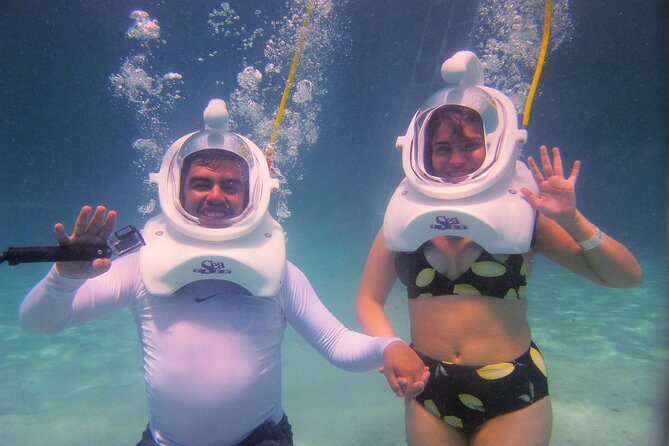
Walking underwater with your head and shoulders kept dry is the appeal here. You descend a seaside ladder wearing a heavy Sea Trek helmet, then follow your guide across the seabed among fish and coral. No swimming or snorkel skill is needed, which makes this a friendly way to see marine life without putting your face in the water.
I like the small groups of four, since your guide can watch your footing and answer questions without shouting across a crowd. I also like the free snorkel gear afterward. You can stay at the park and see more of the water instead of treating the 25 to 35 minutes on the bottom as your entire outing.
The main concern is the setting. This is not a grand reef expedition, and the bottom near the entry can feel rocky. Helmet fit and balance may also be an issue for some people, so ask questions before entering the water.
Key points to know before you book
- The helmet keeps your head and shoulders dry: You breathe normally while walking underwater, making this suitable for many non-swimmers.
- Bottom time is usually 25 to 35 minutes: The complete visit lasts about 1 hour and 20 minutes, including preparation.
- Groups are limited to four people: Larger parties must book separate time slots.
- You pay $19 cash for park entry: This is not included in the $79 Sea Trek price.
- Snorkeling comes afterward: Gear, lockers, bathrooms, and showers are included.
- The underwater setting is modest: Expect fish and coral, but do not book this expecting a large, untouched reef.
What walking underwater at Chankanaab feels like
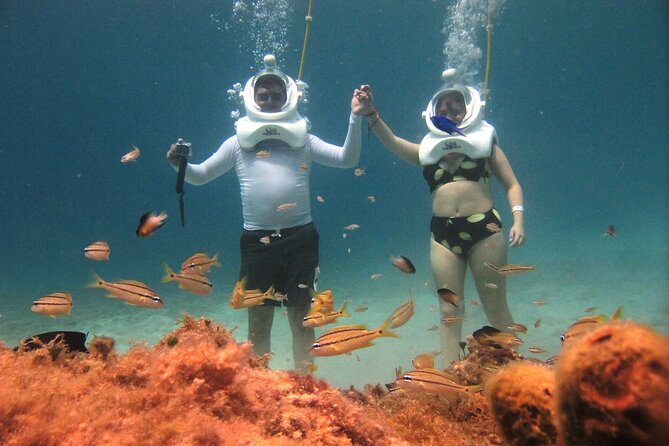
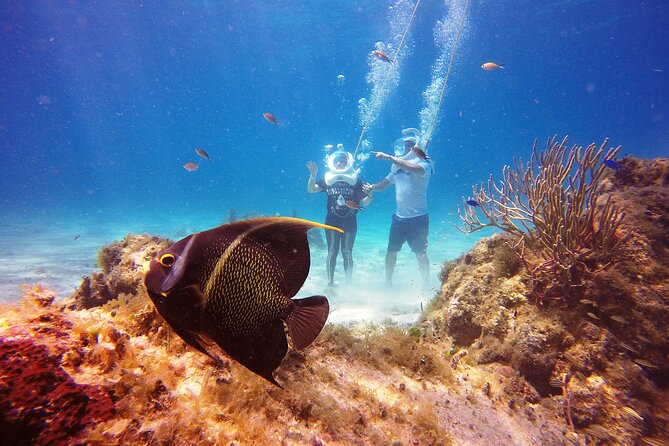
Sea Trek uses a helmet that rests over your head and supplies air while keeping your head and shoulders dry. You are not swimming along the reef. You are walking on a white sandy bottom, with your feet on the seabed and your guide nearby.
That difference matters. If you are uneasy in open water, the experience can feel much more manageable than snorkeling. You do not need to float, kick, or coordinate a mask and snorkel. The helmet does the breathing work, and the guide explains how to move safely before you enter.
You should still expect the sensation of being underwater. The helmet is heavy, and your balance may feel unfamiliar at first. The entrance and nearby bottom can be rocky, so take your time when stepping down and finding secure footing.
The guide points out fish, coral, and other items of interest as you walk. The marine life is real and unscripted. You might see several kinds of coral and fish, but the quantity can vary. The operator does not feed fish to draw them toward the route, a choice that keeps the experience closer to natural behavior but may mean fewer fish gather in one place.
More National Park Hikes in Mexico:
- Huatulco: National Park Hiking and Snorkeling Tour
★ 4.8 · 9 reviews - San Francisco: Yosemite National Park & Giant Sequoias Hike
★ 4.5 · 1,777 reviews - Skaftafell National Park: Falljokull Glacier Advanced Hike
★ 4.8 · 1,083 reviews
The safety briefing comes before the water
Before the helmet goes on, your guide explains how Sea Trek works and how to use it safely. This is the moment to mention any concern about balance, ear pressure, or helmet fit.
The helmet must sit properly, and you should not simply accept discomfort because the activity has already begun. One person reported that the helmet felt as if it wanted to lift and that the air hoses became twisted. The operator responded that the helmets are weighted and said they had not experienced an accident, but the practical lesson is simple: speak up immediately if something feels wrong.
You can stop and return to the surface at any time. The operator says normal bottom time is kept between 25 and 35 minutes, similar to a basic compressed-air underwater session. The advertised experience is about 1 hour and 20 minutes overall, but the time actually walking on the bottom is shorter because it includes preparation and entry.
One published account recorded a 28-minute underwater period, which fits that stated range. If you are promised a particular duration by staff, it is reasonable to clarify whether that means total activity time or time on the seabed.
Entering the water by the seaside ladder
Once the briefing is finished, the guide places the helmet over your head. You then descend a seaside ladder toward the ocean floor. This is the least graceful part for many people, since the helmet is heavy and your movement is restricted.
Do not rush this step. Keep both hands where the guide tells you, take each rung carefully, and let the staff help you settle. If you are not a swimmer, this is where calm instructions matter most. A guest who could not swim described the experience as easy and credited guide Jose and his work partner with helping from start to finish.
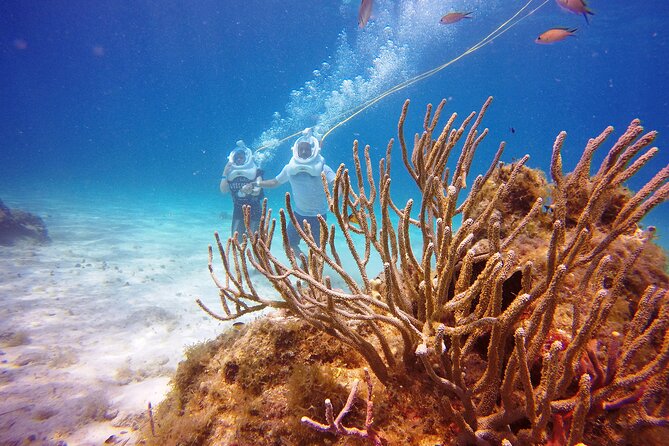
At the bottom, you walk on the sandy floor. Your guide stays close and points out marine life. The park’s water can offer fish and coral, but this is a relatively controlled shore-based experience rather than a long route through a broad reef system.
That distinction helps set the right expectation. If you want a simple introduction to underwater viewing, the setting can work well. If your main goal is a dense reef filled with constant activity, you may find the marine scenery limited.
What you may see below the surface
The route includes several species of coral and fish, with the guide identifying points of interest along the way. You may also be able to see dolphins in the nearby area, as one participant reported. The dolphins are not described as part of the Sea Trek program, so treat that as a possible sight rather than a promised feature.
The underwater scene can change from one session to the next. Fish move. Visibility and weather affect what you see. The choice not to feed fish is worth noting because it gives the encounter a more natural feel, but it also means you should not expect a guaranteed swarm at the helmet window.
A critical account found little to see and felt the rocky bottom made walking hard. Another person described the reef life as limited but still called the activity a cool experience. Both impressions can be true. Sea Trek gives you an unusual way to stand underwater, but it does not turn a modest shore site into a major reef destination.
More hikes and treks around Mexico:
- Matacanes : Canyoning + Hiking + Water Jumps + Rappel + Caves
★ 5.0 · 1,497 reviews - Nido de los Aguiluchos, Monterrey: Hiking + Rock Climbing + 3 Rappels
★ 5.0 · 713 reviews - Puerto Vallarta: Full Day Hike to 6 Hidden Beaches & Snorkel
★ 4.8 · 403 reviews - Los Cabos: Hiking at the Fox Canyon with Waterfall
★ 5.0 · 369 reviews
Helmet fit, body size, and comfort
The minimum age is eight, and the minimum weight is 80 pounds, or 36.3 kilograms. There is no stated maximum weight or head measurement, which makes it hard to predict fit in advance.
One person had trouble getting a hand through the front opening because of head and chin size. That made equalizing ear pressure difficult. The same person also found it harder to stay balanced while walking because of buoyancy. The operator said this was unusual and asked for head-girth information to help improve the description.
You should take that exchange as useful practical advice, not as a reason to dismiss the activity. Helmet fit can vary by person, and the equipment has to suit your head and face comfortably. If you have a larger head, a fuller chin, or concerns about staying steady underwater, contact Sea Trek Cozumel before booking and ask what fit checks are available.
The helmet is heavy by design, but weight alone does not guarantee easy walking. You need to feel stable on the bottom. Comfortable shoes are not mentioned as part of the required equipment, so do not assume special footwear is provided. The supplied equipment includes the Sea Trek helmet and later-use snorkeling gear.
Small groups make a real difference
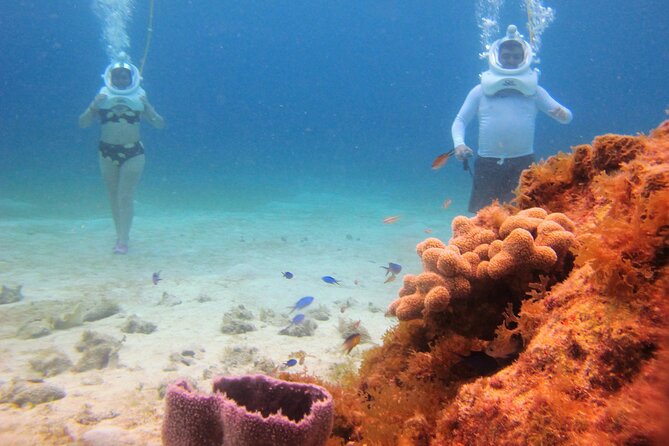
The standard group limit is four people. That is one of the strongest features of this experience. With fewer people around the guide, you are more likely to receive individual help with the ladder, helmet, footing, and questions.
A solo booking may feel almost private if no one else is scheduled at the same time. One person had a guide take pictures with their camera, which is a useful reminder to ask staff before entering if you want a photo. Do not assume photography is included as a formal service, but bringing your own camera may be worthwhile if the staff can safely handle it.
Groups larger than four need an additional time slot. The provider says its downtown location can accommodate up to eight people, but this booking is at Chankanaab Adventure Beach Park. The downtown location also uses guide ropes, while this park experience may not. That difference matters if you want a fixed route with something to hold or follow.
Because sessions can slow down during peak periods or with large parties, avoid booking another time-sensitive activity immediately afterward. A ship departure, restaurant reservation, or second excursion leaves little room for delays.
Snorkeling after Sea Trek
After you return to shore, you can stay at Chankanaab and use the included snorkeling equipment. This makes the experience more useful than a short underwater walk followed by an immediate departure.
Snorkeling gives you a different view. With Sea Trek, you stand on the bottom and look around from a fixed height. With a mask and snorkel, you can move across the surface and cover more area. You may also prefer one method over the other once you learn how the water feels.
Free lockers, bathrooms, and showers are included. The locker supply has not always been fully reliable, so bring only what you need and ask staff where valuables should go. The availability of showers is especially handy after saltwater time, but the park entrance itself remains a separate cost.
If you are not a swimmer, you are not required to snorkel afterward. The extra equipment is an option, not a second obligation. You can use the facilities and remain at the park without adding another water activity.
Is $79 a fair price?
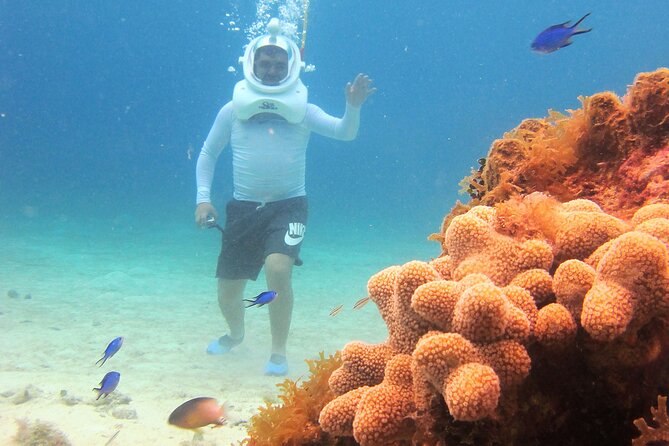
The Sea Trek cost is $79 per person. You must also pay $19 in cash per person at the Chankanaab gate, bringing the known total to $98 per person before any other personal spending.
That price is reasonable if the helmet walk is the main item on your Cozumel wish list and you value a small group. The price includes the helmet, instruction, a guide, lockers, showers, and snorkeling equipment. You are also paying for access to a controlled underwater activity that does not require swimming experience.
The value is weaker if you want a full reef day. The underwater route is fairly short, and the marine life may be sparse compared with what you imagine from Cozumel. You are paying for the unusual act of walking underwater, not for a long exploration of a large reef.
I would also factor in the $19 cash requirement. Bring the correct amount so the park entrance does not become an avoidable snag. Since the experience ends back at the meeting point, you can make a full visit of the park, but the Sea Trek fee itself does not include general park admission.
Getting there and planning your time
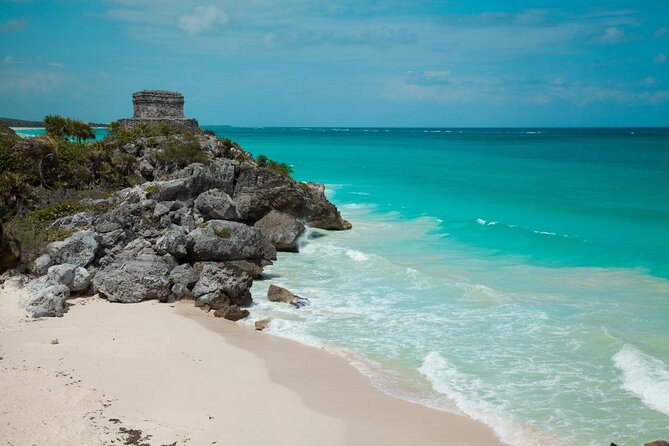
The meeting point is Chankanaab Beach Adventure Park inside Cozumel’s National Reef Marine Park, at Carr. Costera Sur Km. 9, Zona Hotelera Nte., Cozumel, Quintana Roo 77688. The activity ends at the same place.
The site is near public transportation. The supplied details do not promise hotel pickup, so plan to reach the park on your own unless your booking confirmation says otherwise. Allow extra time for the $19 cash entrance payment and for locating the Sea Trek meeting area.
The activity is offered in English. Confirmation is received when you book, and free cancellation is available until 24 hours before the start time. Changes or cancellations inside that 24-hour window are not refunded, and poor weather can lead to a new date or a full refund.
The weather rule matters in Cozumel. Even a well-organized water activity can be affected by rough conditions. Check the local time and keep your schedule flexible, especially if this is one part of a cruise-day plan.
Who should book this experience?
I would recommend Sea Trek to a first-time underwater explorer who does not swim or does not enjoy snorkeling. The helmet lets you breathe and keep your face out of the water, while the guide stays nearby and the group remains small.
It also suits families with children age eight and older who meet the 80-pound minimum, provided the child is comfortable with the helmet and the ladder. Adults who want a novel activity rather than a serious reef session may enjoy it most.
I would be cautious if you have concerns about helmet fit, balance, or ear pressure. I would also choose another water outing if your priority is a broad, fish-heavy reef. The published overall score is 3.3 from nine ratings, a mixed result that fits the experience: some people find it easy and memorable, while others find the site, equipment fit, or marine life disappointing.
My recommendation for Chankanaab Sea Trek
Book it if you want the novelty of walking underwater without swimming, appreciate close guide attention, and plan to use the included snorkel gear afterward. The best parts are the simple breathing system, the small groups, and the help provided by guides such as Jose.
Think twice if you expect a dramatic reef, a guided rope route, or perfect equipment fit without asking questions. Confirm the helmet will suit you, bring $19 cash for park entry, allow extra time, and do not schedule a tight connection afterward. With those expectations, Sea Trek can be a pleasant one-time adventure. Without them, the $98 known cost may feel high for a short walk over a modest seabed.
FAQ
Do I need to know how to swim?
No. Swimming, snorkeling, and underwater experience are not required. You breathe through the Sea Trek helmet while walking on the ocean floor.
How long does the activity last?
The complete experience lasts about 1 hour and 20 minutes. The stated underwater bottom time is generally 25 to 35 minutes, with the rest used for instruction, equipment, and entry.
What is included in the $79 price?
The price includes use of the Sea Trek helmet, instruction, snorkeling equipment for afterward, lockers, bathrooms, and showers.
How much is Chankanaab Park admission?
Park admission costs an additional $19 per person. It must be paid in cash at the gate.
What are the age and weight requirements?
The minimum age is eight. The minimum weight is 80 pounds, or 36.3 kilograms. No maximum weight or head measurement is specified, so ask about helmet fit if you have concerns.
How many people are in each group?
Groups are limited to four people at this location. Larger parties must purchase another time slot. The provider says its downtown location can accommodate up to eight people.
Just added around Mexico
- Colima Volcano Trekking Plus Kayaking in a Crater Lake★ 5.0 · 28 reviews
- Hiking Tour on the Iztaccíhuatl Volcano from Puebla★ 5.0 · 44 reviews
- Hiking Tour to volcano La Malinche from Puebla (private tour)★ 5.0 · 17 reviews
- Hiking Todos Santos at Sunset★ 5.0 · 46 reviews
- Private Hiking at the Fox Canyon from Cabo San Lucas★ 5.0 · 68 reviews
- Hike the native Pericu road in Sierra de la Laguna.★ 5.0 · 92 reviews
- Snorkel Adventure and Hike to a Hidden Beach★ 5.0 · 74 reviews
- From San Miguel de Allende: Hiking in the Canyon with Lunch★ 5.0 · 28 reviews
National Park Hikes, side by side.
Skaftafell National Park: Falljokull Glacier Advanced Hike
Read our review →
Everglades National Park Biologist Led Adventure: Cruise, Hike + Airboat
Read our review →
Doi Inthanon National Park and Pha Dok Siew Trek
Read our review →
Marseille: Calanques National Park Guided Hike with Picnic
Read our review →
From Marseille: Calanques National Park Guided Hike
Read our review →
From Kuala Lumpur: Taman Negara National Park Trek Day Tour
Read our review →
This walk also sits in