

REVIEW · JAPAN
Private Local Hiking to enjoy the nature and culture of Mt.Fuji
Mt. Fuji is more than the famous cone in the distance. This private outing takes you into the mountain’s older spiritual world, through Fuji Omuro Sengen Shrine, a sacred lava cave, Aokigahara Forest, and the quieter shores of Lake Saiko. The main hike to Sankodai brings together Fuji, the forest, and the lake in one broad view when the weather cooperates.
I like two things right away. Yuki’s local background gives the day unusual depth: he is a certified mountain guide, has climbed Mt. Fuji more than 40 times, and is also a licensed local hunter. I also like the mix of walking and local life, with Yoshida Udon at a small restaurant followed by matcha and a Japanese sweet in a traditional garden.
The main consideration is weather. Fuji can disappear behind clouds, and the Sankodai view is the centerpiece of the hike. The trail is suitable for outdoor beginners, but you still need to be comfortable walking uphill for about an hour and downhill for roughly 30 minutes.
Key points at a glance
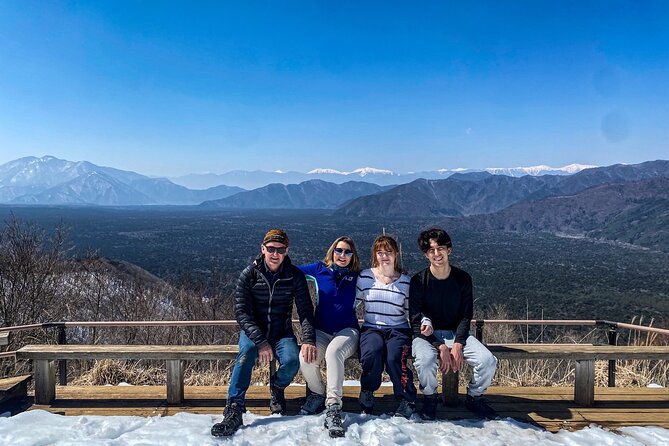
- Sankodai’s three-part view: On a clear day, you can see Mt. Fuji, Lake Saiko, and the Aokigahara forest from the same viewpoint.
- A guide with a strong local connection: Yuki combines mountain experience, Fuji worship history, and knowledge of the area as a licensed hunter.
- A quieter side of the Fuji Five Lakes: Lake Saiko and the forest feel far removed from the busier sights around Lake Kawaguchiko.
- Free outdoor equipment: Trekking shoes, poles, rainwear, and gloves are available to use.
- Food and culture after the hike: Yoshida Udon costs about 1,000 yen, while optional matcha and a Japanese sweet cost about 1,000 yen.
- A private half-day outing: Only your group takes part, with private transportation included.
A different way to meet Mt. Fuji
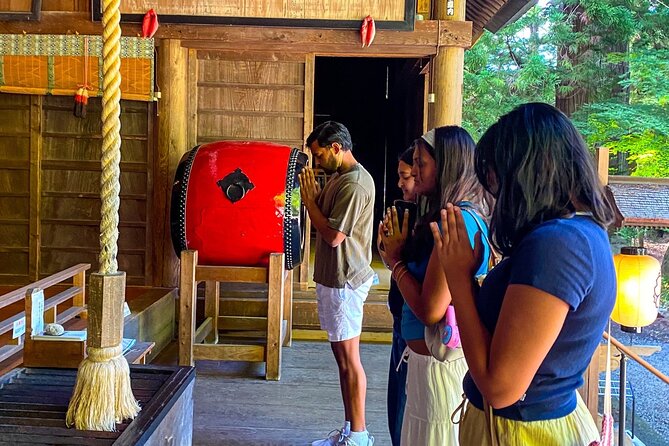
This is not a summit climb. It is a moderate nature and culture outing at the foot of the mountain, designed to show you why Fuji has mattered to local people for centuries.
The day starts at 9:00 a.m. and lasts about five to six hours. You move between several sites by private transportation, then spend the central part of the day on foot. That arrangement works well because the area’s highlights are spread out. You get a real walk in the forest without spending the entire day on a demanding trail.
The private format also changes the pace. You are not tied to a large group moving at one speed. Yuki can spend extra time explaining a shrine, adjust the route to the conditions, or give you a pause at the viewpoint. The supplied details note that he has sometimes spent more time with a group than the scheduled length, but you should still treat five to six hours as the planned duration.
Pickup is available only if you are staying in the Kawaguchiko or Fujiyoshida area, or if you can reach one of those areas on your own. This is important. The tour does not offer general pickup from anywhere in the wider Tokyo region.
More Mountain and Summit Hikes in Japan
- Full Day Hiking Tour at Mt.Takao including Hot Spring
★ 5.0 · 52 reviews - Hike Japan Heritage Hakone Hachiri with certified mountain guide
★ 5.0 · 46 reviews - Explore Kiso Valley : Magome – Tsumago Mountain Trail Walk
★ 5.0 · 33 reviews
Fuji Omuro Sengen Shrine and the mountain’s spiritual side
The first major stop is Fuji Omuro Sengen Shrine. This ancient shrine is linked to Fuji worship and to the area’s largest eruption.
Local people built the shrine in hopes of calming the mountain after that destructive event. The story gives you a useful key to the rest of the day. Mt. Fuji is not only a scenic landmark. It has long been treated as a sacred force, and the surrounding caves, forests, and paths carry that sense of respect.
You spend about 15 minutes here, with no admission charge. That is enough time to look around and hear the basic story without turning the stop into a long formal shrine visit. Yuki’s background is especially useful here because he can connect the visible site to Fuji’s religious traditions.
If you want a tour focused only on panoramic photos, this stop may feel brief. If you like seeing how a place shaped local customs, it gives the hike more meaning.
Lake Kawaguchiko, Lake Saiko, and the value of going quieter
Lake Kawaguchiko is the best-known of the Fuji Five Lakes and the area’s main tourist base. Its combination of water and Fuji attracts large numbers of visitors, so it can feel busy at popular viewpoints.
This tour also takes you to Lake Saiko, which has a calmer character. You spend about 10 minutes there, looking across the lake toward Fuji when the mountain is visible. The stop is short, but it helps you compare the two lakes and see a less crowded part of the region.
The view depends heavily on cloud cover. Fuji is often partly or fully hidden, particularly around the mountain’s upper slopes. The tour requires good weather, and if conditions force a cancellation, you are offered another date or a full refund. That policy is useful, but it cannot make the mountain appear on a cloudy day, so keep your expectations sensible.
Aokigahara Forest and the lava beneath your feet
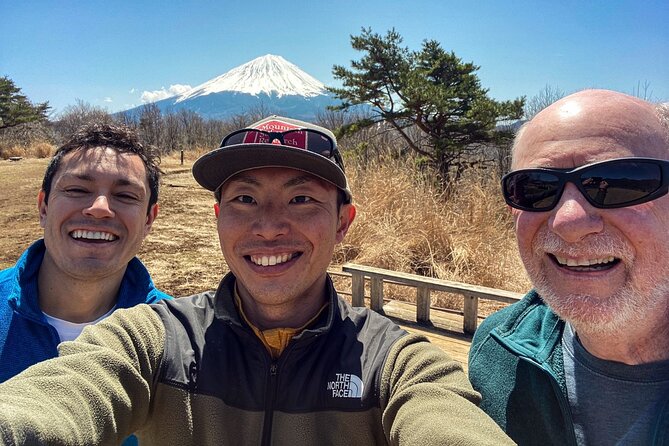
Aokigahara is known locally as Jukai, or the sea of trees. The name comes from the way the forest appears from above, spreading across the ground like a broad green sea.
The forest formed after a major Mt. Fuji eruption about 1,200 years ago. Lava spread across the area and helped create the rough volcanic ground and underground spaces that shape this part of the route.
You spend about 15 minutes learning about Aokigahara before continuing to the cave area. The stop is not a long forest trek on its own, but it provides the geological background for what you see next.
This is also an area where a good guide matters. Forests and lava fields can look similar from one path to the next. Yuki’s explanations help turn the trees and rock into a readable story about eruptions, worship, and local life.
More Private Hiking Tours in Japan:
- Fushimi Inari Hidden Hiking Tour (Private Option Available)
★ 5.0 · 1,750 reviews - Private Hiking Tour to View Mt. Fuji
★ 5.0 · 10 reviews - Walk the Ancient Pilgrim Paths of Mt. Fuji – Private Tour
★ 5.0 · 10 reviews - Mount Batur Sunrise Trekking Private All Inclusive
★ 5.0 · 906 reviews
Ryugudoketsu-iriguchi, a sacred lava cave
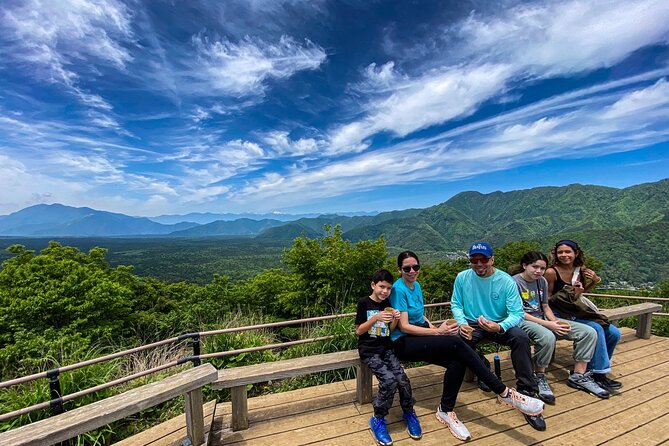
The cave entrance, Ryugudoketsu-iriguchi, offers one of the most unusual parts of the day. People once visited this sacred cave to pray to a goddess associated with Mt. Fuji before climbing the mountain.
The belief was that the cave’s interior represented the inside of the goddess. People began climbing into it as part of their prayers. You spend about 30 minutes here, giving the site more time than the earlier shrine and lake stops.
The cave also shows how the region’s geology and religion overlap. An eruption created the volcanic rock, and local beliefs gave the cave spiritual importance. You are not simply looking at a hole in the ground. You are seeing a place where the physical mountain and the sacred mountain meet.
Free trekking shoes, poles, rain jackets and pants, and gloves are included. That is helpful around volcanic terrain and in changeable weather. The provided information does not specify cave access restrictions, so follow Yuki’s directions and wear the supplied equipment if conditions call for it.
The Sankodai hike, about 90 minutes on the trail
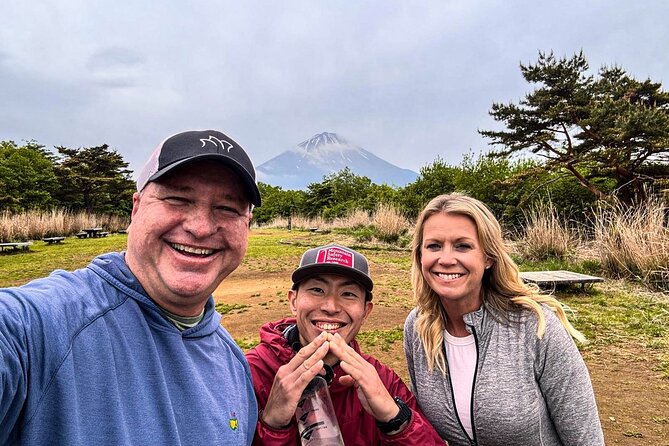
Sankodai is the main walking section and the visual high point of the outing. The stated hiking time is about one hour up and 30 minutes down, or roughly 90 minutes in total. Some descriptions also characterize it as about two hours round trip with a break at the top, so allow a little flexibility rather than planning your next appointment too tightly.
The trail is described as suitable for outdoor beginners. That does not mean it is flat. You should expect a steady uphill walk, followed by a shorter descent. Good shoes help, and the free trekking shoes and poles can make the route easier if you did not bring suitable gear.
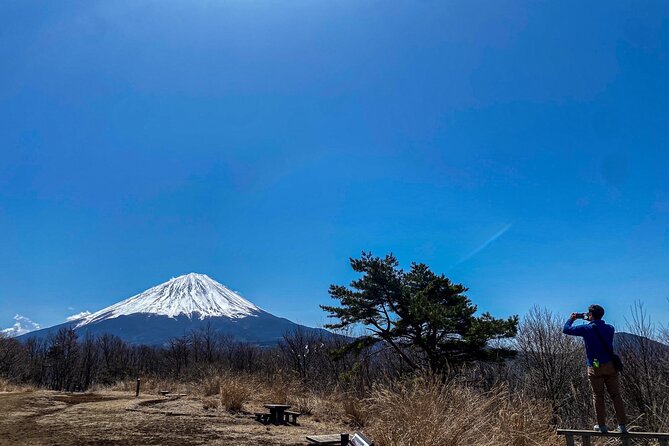
The reward is the Sankodai viewpoint. On a clear day, you can look toward Mt. Fuji, Lake Saiko, and the broad Aokigahara forest at the same time. This combination is stronger than a standard roadside Fuji photo because you see the mountain in relation to the water and the forest that surround it.
Yuki’s personal mountain experience adds something practical here. He has climbed Mt. Fuji more than 40 times, so he knows the mountain’s changing conditions and the meaning of the surrounding routes. The guide has also brought coffee, tea, chocolate, and snacks for breaks at the top on past outings. These items are not listed as a formal inclusion, so do not book on the assumption that they are guaranteed, but the thoughtful pause fits the private format.
The biggest weakness of Sankodai is also its main appeal: the view is weather dependent. If the mountain is hidden, the forest and lake still provide a worthwhile setting, but the full three-part panorama will not appear.
Yoshida Udon, a simple meal with local character
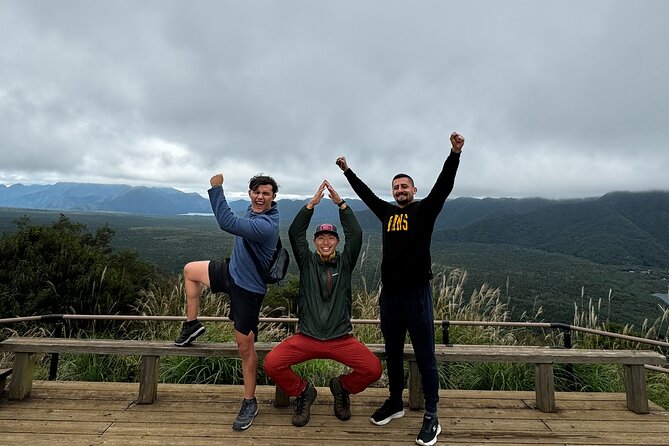
After the walk, Yuki takes you to a local restaurant for the area’s signature dish, Yoshida Udon. The meal is not included in the tour price and costs about 1,000 yen per person.
That small extra cost is easy to understand. You are not stopping at a generic restaurant chosen for convenience. The guide takes you to a place that would be difficult to find without local help, and the dish connects the day to Fujiyoshida’s food culture.
Yoshida Udon is known for its firm noodles, but the exact preparation at the restaurant is not specified. Consider this a practical local meal rather than a long dining event. The listed stop lasts about 30 minutes, so the focus remains on the food and the conversation, not an extended restaurant visit.
If you have dietary restrictions, ask about the meal before booking. The available information does not provide a menu or allergy details.
Matcha in the garden at Kaneyamaen
The final stop is Fujisan Onsen Hotel Kaneyamaen in Fujiyoshida. This is described as one of the city’s oldest hotels, with a large Japanese garden open to the public.
You can walk through the garden and relax after the hike. For about 1,000 yen per person, you can add matcha and a Japanese sweet. The tea is optional, so you can enjoy the garden without paying the extra amount.
I like this ending because it slows the day down. The route begins with a shrine, moves through volcanic forest and mountain paths, then finishes in a cultivated garden with tea. You get several different views of local culture instead of one long walk followed by a rushed departure.
The stop lasts about 30 minutes. It is best viewed as a quiet close to the outing, not as a full tea ceremony. The information provided does not say that a formal ceremony is included.
What the $131.38 price includes
The listed price is $131.38 per person. For a private five to six hour outing, that represents reasonable value if you want transportation, a guide, outdoor equipment, and a route that combines several sites.
Included are private transportation, the guide fee, trekking shoes, trekking poles, rain jackets and pants, and gloves. These inclusions matter in the Fuji area, where weather can change and visitors often arrive without proper hiking gear.
You still pay for lunch, expected to be about 1,000 yen, and matcha with a sweet if you choose it, also about 1,000 yen. Insurance is not included.
The price makes less sense if you only want a short Fuji photo stop or prefer to explore independently. It makes more sense if you value a private vehicle, a flexible pace, local interpretation, and help finding the smaller cultural and natural sites around Lake Saiko and Aokigahara.
Group discounts are available, though the amount is not specified. Since this is a private activity, ask about the discount when booking if you are traveling with several people.
Who should book this Fuji hiking experience
I would recommend this outing to you if you want more than the standard Lake Kawaguchiko viewpoint. It suits people who enjoy moderate walking, local food, shrine visits, volcanic geology, and quiet scenery in the same half-day.
It is also a good choice for first-time hikers. The main route is described as suitable for outdoor beginners, and gear is available at no extra charge. You still need to manage an uphill hour, so this is not a sightseeing bus tour with only flat walks.
Families and mixed-age groups may appreciate the private format because the guide can set a more comfortable pace. The available information says most people can participate, but it does not give a specific minimum age or accessibility details.
You should think twice if your main goal is a guaranteed view of Fuji. No guide can control the clouds. You should also avoid scheduling a tight afternoon appointment because the route, meal, and transport can take the full five to six hours.
Booking confirmation is provided at the time of booking. Cancellation is free up to 24 hours before the start time. Cancellations or changes made less than 24 hours ahead are not refunded or accepted, and all cut-off times use local time.
Should you book it?
Book this experience if you want to understand Mt. Fuji as a place of worship, eruption, forest, food, and daily life, not simply as a photo subject. The combination of Yuki’s mountain background, a moderate trail, private transport, Yoshida Udon, and a Japanese garden makes the day varied without becoming a hard expedition.
Skip it if you need a guaranteed summit view, dislike uphill walking, or only have time for a quick stop near Kawaguchiko. For everyone else, this is a thoughtful way to reach Fuji’s quieter side, with enough practical support to make the outing comfortable.
FAQ
Where does the tour take place?
The tour explores the Mt. Fuji area around Fujikawaguchiko and Fujiyoshida, including Lake Saiko, Aokigahara Forest, and Sankodai.
Can I be picked up from my hotel?
Pickup is available only for people staying in the Kawaguchiko or Fujiyoshida area, or for those who can reach those areas on their own.
What time does the tour start?
The stated start time is 9:00 a.m.
How long does the experience last?
The full experience lasts approximately five to six hours.
Is this a private tour?
Yes. Only your group participates in the activity.
Who leads the tour?
The experience is provided by Yuki. He is a certified mountain guide, has climbed Mt. Fuji more than 40 times, and is a licensed local hunter.
How difficult is the hike?
The trail is described as suitable for outdoor beginners. The main section takes about one hour uphill and about 30 minutes downhill.
Is hiking equipment provided?
Yes. Trekking shoes, trekking poles, rain jackets and pants, and gloves are available free of charge.
Is lunch included?
No. Lunch is not included and is expected to cost about 1,000 yen per person.
Can the tour be canceled because of weather?
Yes. The experience requires good weather. If poor weather causes cancellation, you are offered another date or a full refund.
Just added around Japan
- Hike Japan Heritage Hakone Hachiri (Half Day)★ 5.0 · 18 reviews
- Hike Hakone Hachiri★ 5.0 · 48 reviews
- Traverse Outer Rim of Hakone Caldera and Enjoy Onsen Hiking Tour★ 5.0 · 30 reviews
- Magome & Tsumago Nakasendo Trail Day Hike with Government-Licensed Guide★ 5.0 · 38 reviews
- Frozen fall trekking★ 5.0 · 21 reviews
- Private Hiking Tour to View Mt. Fuji★ 5.0 · 10 reviews
- Walk the Ancient Pilgrim Paths of Mt. Fuji – Private Tour★ 5.0 · 10 reviews
- Oiso: Adventure Hike to See Mt. Fuji & Historic Coastal Walk★ 5.0 · 10 reviews
Mountain & Summit Hikes, side by side.
Berber villages : Atlas Mountains Day Hike from Marrakech
Read our review →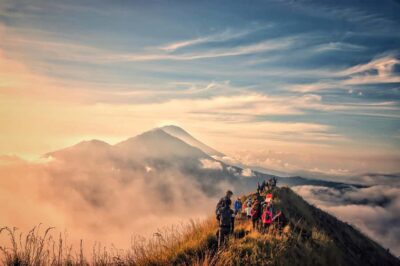
Sunrise Mount Batur Guided Hike with Breakfast
Read our review →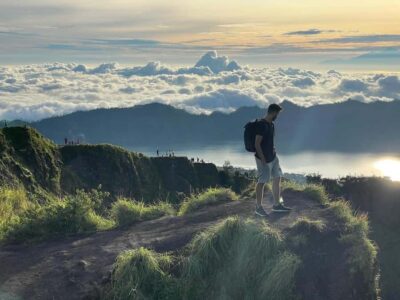
Mount Batur Sunrise Guided Hike and Natural Hot Spring
Read our review →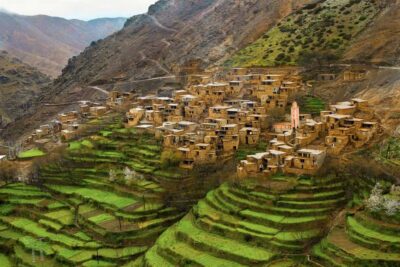
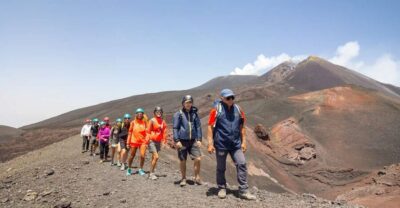
Mount Etna: Summit Guided Hiking Tour up to 3,400 m
Read our review →
Bovilla Lake & Gamti Mountain Hiking Day Trip
Read our review →
Mount Etna: Trek to 3000m with cable car and 4×4
Read our review →
Mount Batur Sunrise Trek With Guide and Breakfast
Read our review →This walk also sits in